Choosing a sectional is the easy part. Knowing what to do with it afterward – how to size it correctly, how to orient it in the room, what materials and colors to build around it – is where most people run into trouble. These sectional living room ideas cover every major color, style, and layout scenario, from small apartment spaces to large open-plan rooms with a fireplace. Keep this guide close when you are ready to make decisions.
Best Sectional Living Room
The sectional does not make the living room. The decisions you make around it do.
That distinction matters because most people approach a sectional purchase the wrong way around. They fall for a sofa in a showroom, bring it home, and then try to build a room around something that was never planned as an anchor piece. The result is a space that feels incomplete – a large, comfortable sofa that somehow makes the room look worse rather than better.
The reason this happens is structural. A sectional is not just furniture. In most living rooms, it is the largest single object in the space, and its placement, scale, and color dictate everything else: traffic flow, sightlines, the size of the rug, the height of the coffee table, the position of the accent chair. Get those downstream decisions right and the room resolves itself. Get them wrong and no amount of styling fixes the problem.
Here are 15 sectional living room ideas for 2026. Each one is built around a specific color, layout challenge, or design scenario – with clear reasoning for why each approach works, not just what it looks like. Whether you are starting from scratch or trying to make an existing sectional work better, you will find a practical direction here.
Cream Sectional Living Room Decor
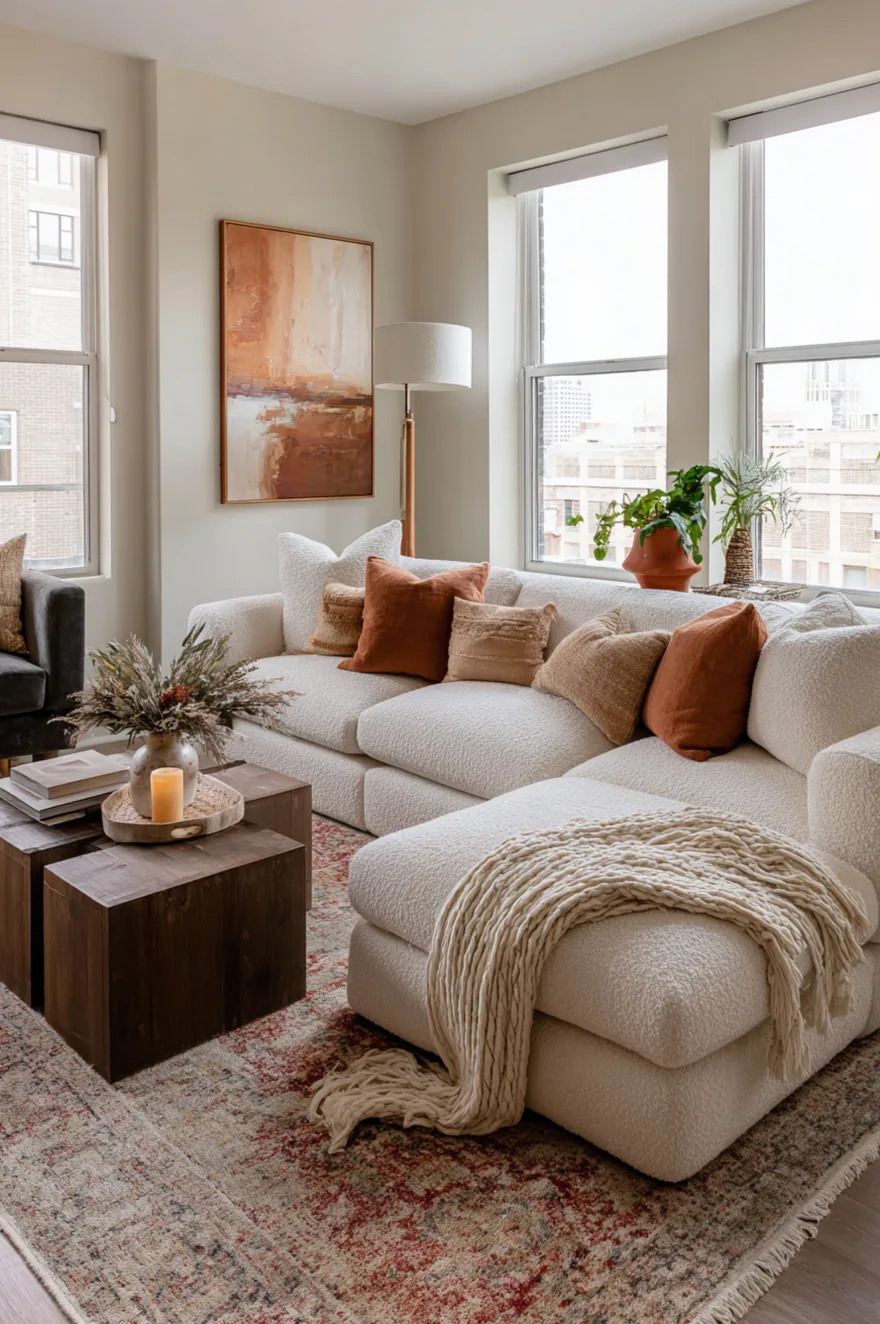
The case against cream sectionals is usually about practicality – they show wear, they require more maintenance, they are not forgiving. The case for them is stronger: a cream or warm white sectional gives a living room more design flexibility than almost any other color choice. It works as a neutral foundation, it reflects light, and when the surrounding decor is done correctly, it reads as genuinely warm rather than cautiously safe.
The key variable is fabric. A cream sectional in boucle, textured linen, or a tightly woven cotton holds its visual warmth even in rooms with cool light. Smooth fabrics – particularly performance weaves with a slight sheen – tend to read as clinical. The texture of the fabric is doing as much work as the color itself. From there, the surrounding palette needs one element that reads significantly darker than the sofa: a walnut coffee table, a charcoal accent chair, a dark-toned area rug border. Without that anchor, the room loses contrast and starts to look unfinished.
For throw pillows, the instinct to go all-white or all-cream on a cream sectional is understandable but counterproductive. Introduce two or three tonal steps of warmth – oat, warm taupe, soft terracotta – and the sectional starts to read as a deliberate color choice rather than a default. A chunky knit throw in a slightly deeper cream or warm oat adds the textural weight that makes the sectional feel like the room’s anchor rather than its largest piece of blank space.
Grey Sectional Living Room Ideas
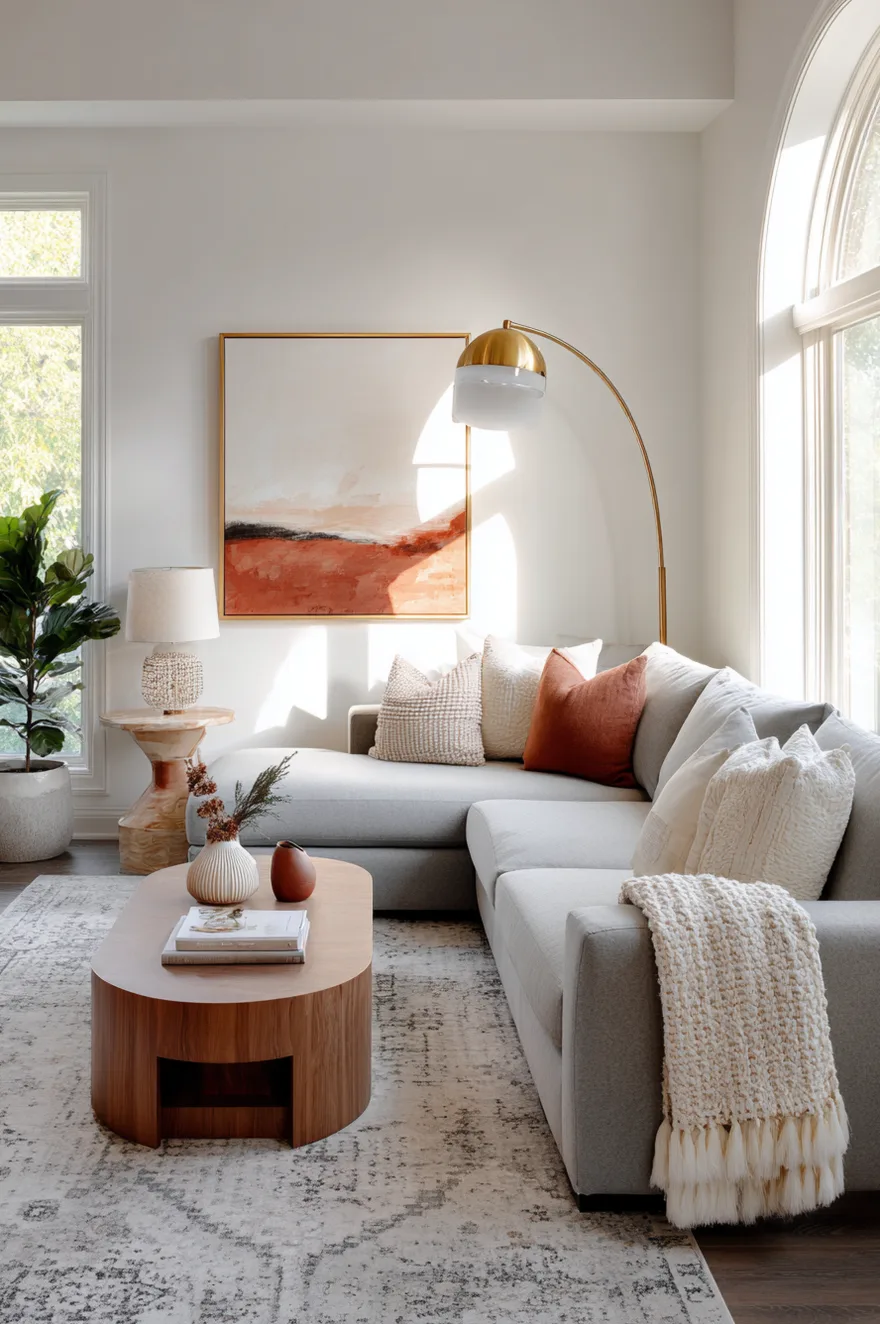
Grey is the most purchased sectional color category for good reason – it is genuinely versatile, it hides daily wear better than lighter tones, and it sits neutrally enough that surrounding decor choices have real flexibility. The problem is that grey without deliberate warmth reads as cold, and a cold living room never feels comfortable regardless of how well it is styled.
The solution is not to avoid grey. It is to understand that grey requires active counterbalancing. Every warm element you introduce – an oak coffee table, a cream area rug, brass pendant light, terracotta throw pillow – is doing structural work in the room, pulling the temperature up so the grey reads as calm rather than clinical. The warmer and more layered the surrounding materials, the more sophisticated the grey sectional looks. The more sparse and cool the surroundings, the cheaper it reads regardless of actual quality.
For a modern sectional living room design with grey specifically, the most effective approach is to let form do the warming work rather than color. A curved coffee table, an arched floor lamp, a round ottoman – these softer shapes counterbalance the hard geometric presence of a large sectional in a way that makes the room feel considered. One or two deeper-toned pillows in navy or charcoal give the grey sofa visual depth it does not have on its own.
Leather Sectional Living Room Decor
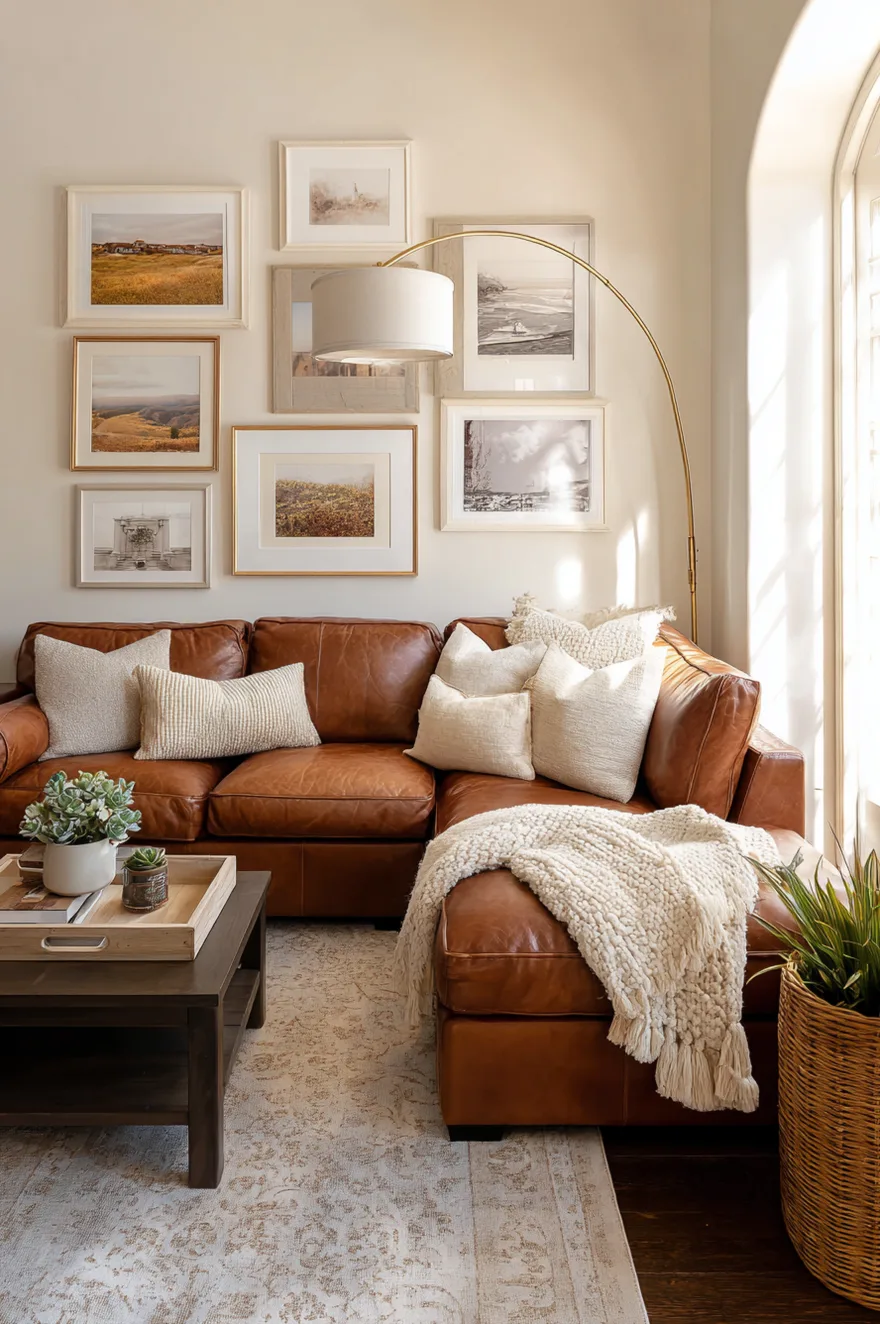
Leather sectionals fail in residential spaces for one consistent reason: they are surrounded by other hard, smooth materials. The leather itself is not the problem. A tan or cognac leather sectional has genuine warmth in the grain and tone of the hide. The issue is when it sits on a polished floor, faces a glass coffee table, and is lit by recessed downlights. Every hard surface amplifies the others, and the room ends up feeling like a hotel lobby rather than a home.
The correction is tactile contrast. A jute or wool area rug with visible weave texture underneath a leather sectional immediately changes the room’s register. Linen or cotton throw pillows rather than leather or faux leather ones. A solid wood coffee table with some grain character rather than a glass or lacquered surface. These choices introduce softness that the leather itself cannot provide, and the result is a room where the leather reads as rich and grounded rather than cold.
For dark brown or black leather sectionals specifically, the surrounding palette should trend significantly lighter. Cream walls, a light to mid-toned area rug, and pale throw pillows create the contrast that lets a dark leather sectional read as an intentional design anchor. One metallic accent – a brass floor lamp, unlacquered brass hardware on nearby furniture – catches light in a way that lifts the room’s energy without disrupting the dark, grounded quality of the sofa.
Sectional Living Room Layout For Small Space
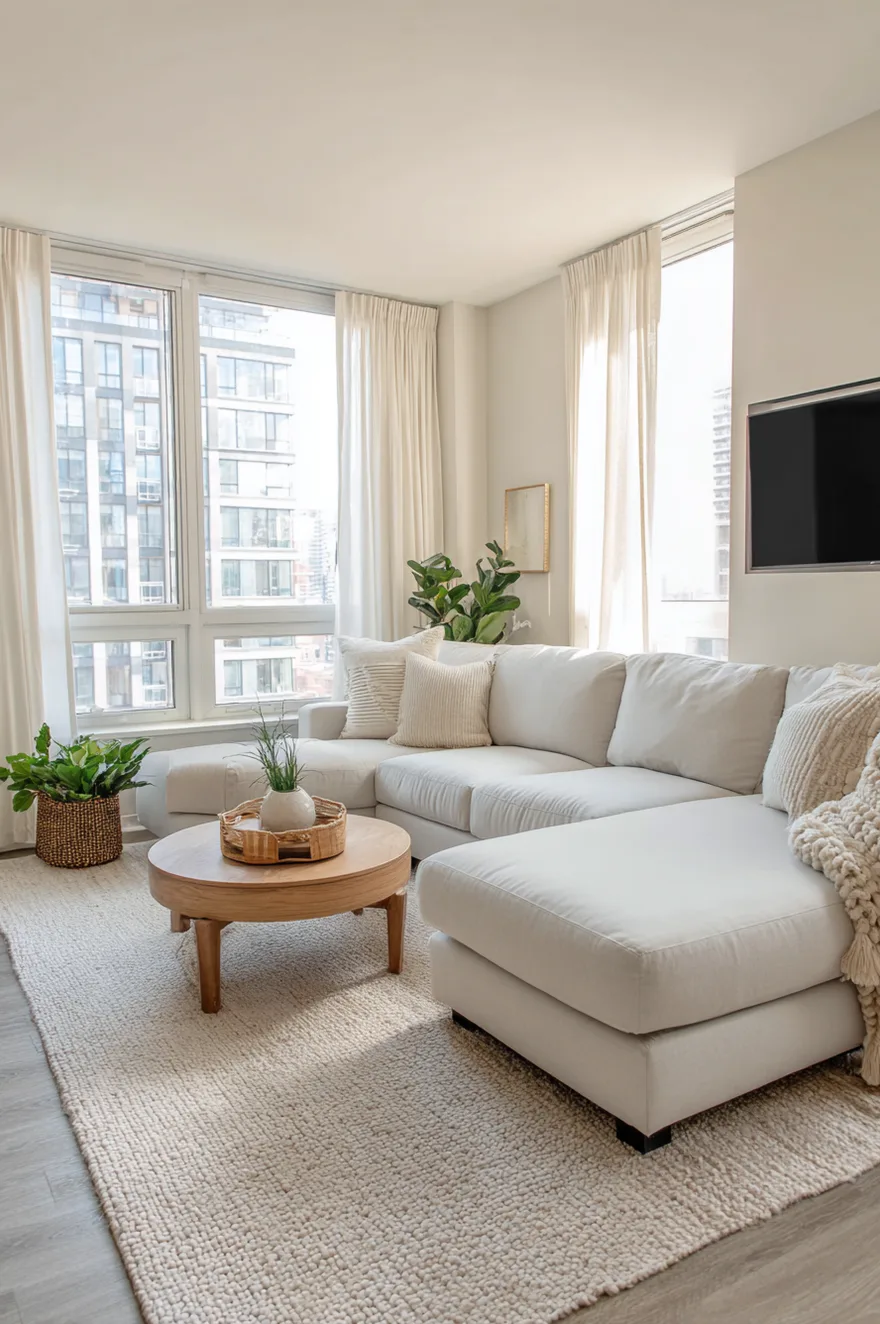
The most common small-space sectional mistake is a scale problem – choosing a sectional sized for the room the buyer wanted rather than the room they have. A sectional that crowds its space does not just look wrong. It physically impairs how the room functions. Traffic cannot flow, seating feels claustrophobic, and the room becomes harder to use on a daily basis, which defeats the purpose of investing in comfortable seating in the first place.
The practical sizing rule: in any living room under 14 feet wide, the sectional’s longest dimension should not exceed 110 inches. In rooms under 12 feet wide, 95 to 100 inches is a more appropriate ceiling. A compact L-shape or single-chaise configuration almost always outperforms a full U-shape or oversized L in these dimensions – the footprint is smaller, the traffic clearance is better, and the room reads as appropriately scaled rather than overwhelmed.
Beyond sizing, two layout decisions have the greatest impact on how spacious a small sectional living room feels. First, choose a round coffee table over a rectangular one – the absence of corners reduces both visual and physical bulk in tight circulation paths. Second, mount the television on the wall rather than placing it on a console. A floor-level media console in a small room consumes significant visual space along the primary sightline. A wall-mounted screen with minimal or no console beneath it returns that space to the room.
Navy Blue Sectional Living Room
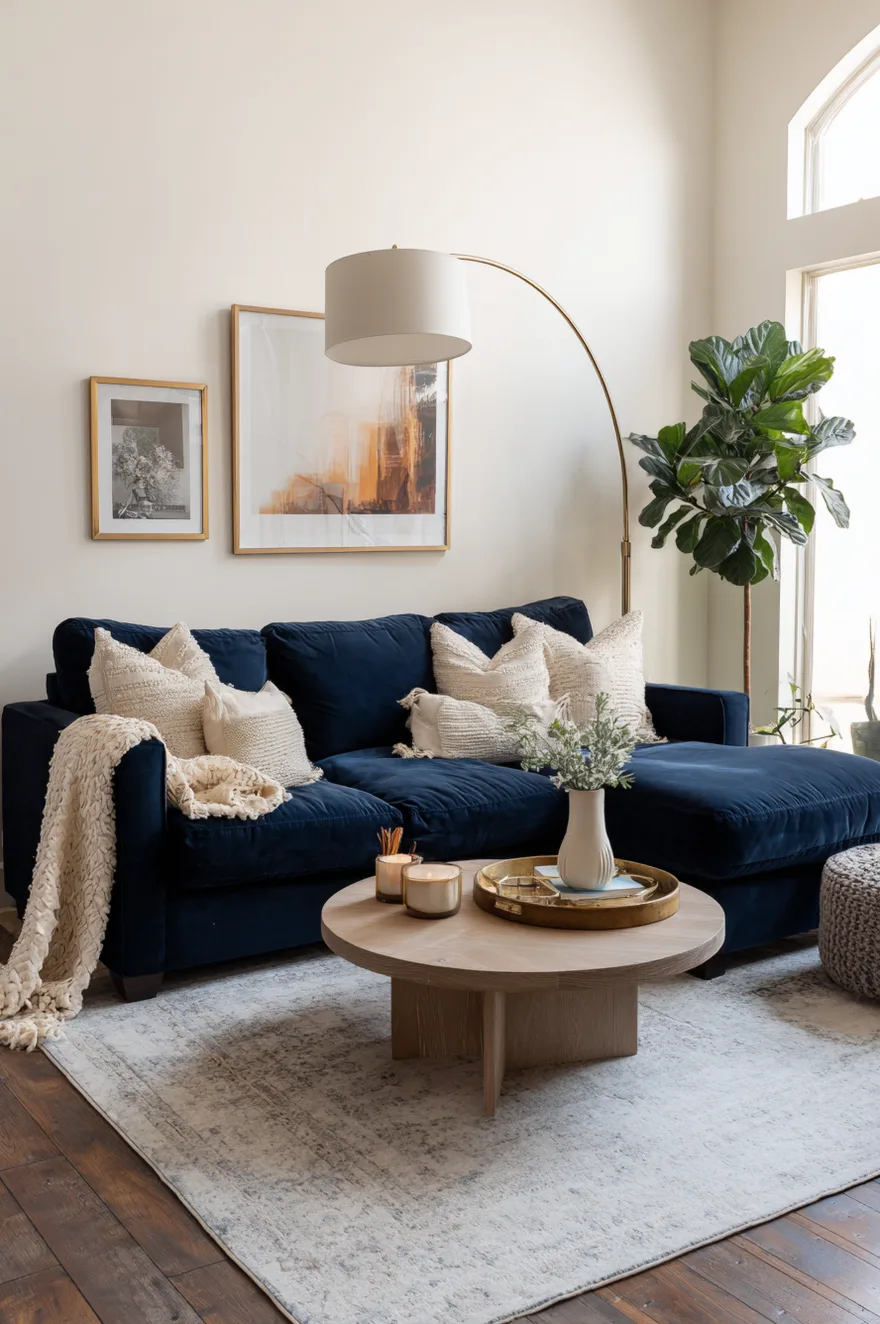
Navy is one of the most underused sectional colors in residential design, which is worth examining. The hesitation is usually about darkness – people assume a navy sofa will make a room feel heavy or small. In practice, navy behaves quite differently from other dark colors because it reads as a deep tone rather than a dark one. It has inherent richness rather than weight, which gives it more design range than charcoal or black.
The material pairing that works best with a navy sectional is warm brass or unlacquered gold. The contrast between the cool depth of navy and the warm reflectivity of brass creates a tension that reads as deliberate and sophisticated. Cream or warm ivory throw pillows in textured fabrics – waffle weave, boucle, slubbed linen – add lightness without competing with the navy’s depth. A medium oak or warm walnut coffee table grounds the arrangement with natural warmth.
The wall color decision matters significantly with navy. Warm white or the palest warm grey keeps the room airy and makes the navy sectional read as a rich accent within a light space. Deeper wall tones risk making the navy disappear into the surroundings, which loses the visual impact that makes a navy sectional worth choosing. Large-scale greenery – a fiddle leaf fig or bird of paradise – introduces organic softness that balances the structured saturation of the navy without diluting it.
Sectional Living Room With Fireplace
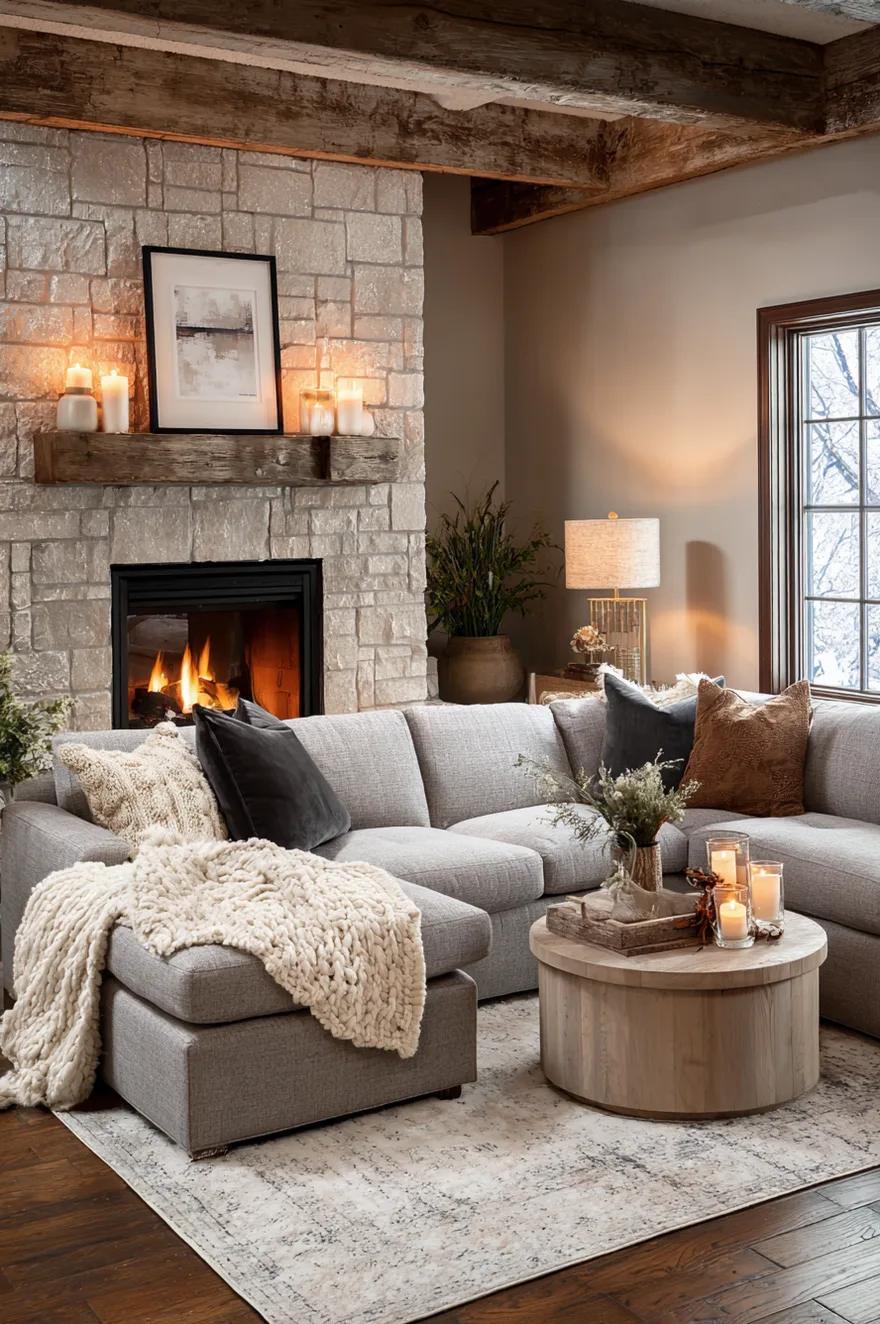
A sectional living room with a fireplace presents a specific spatial problem: two competing focal points. The fireplace is a fixed architectural feature that naturally draws the eye. The sectional, by volume, is the dominant piece of furniture in the room. How you resolve the relationship between them determines whether the room feels designed or just furnished.
The most functional layout for an L-shape sectional with a fireplace is orienting the long side of the L parallel to the fireplace wall, with the chaise extension angled into the room. This creates a conversation zone that faces the fire directly while keeping one side of the room open for circulation. The coffee table in the center of this arrangement should be round or oval – the absence of parallel edges softens the geometry of the L and makes the seating zone feel less rigid. The area rug needs to be large enough that all legs of the sectional sit on it, not just the front feet.
For U-shape sectionals in larger rooms with a fireplace, the open end of the U oriented toward the fire creates an enclosed gathering space that performs exceptionally well functionally. The trade-off is that a U-shape requires significant floor space – typically a minimum of 16 feet of width – to avoid crowding the fireplace wall. Flanking the mantel with matched table lamps balances the visual weight of the large sectional opposite and prevents the fireplace from being visually overwhelmed by the sofa mass.
Charcoal Sectional Living Room Ideas
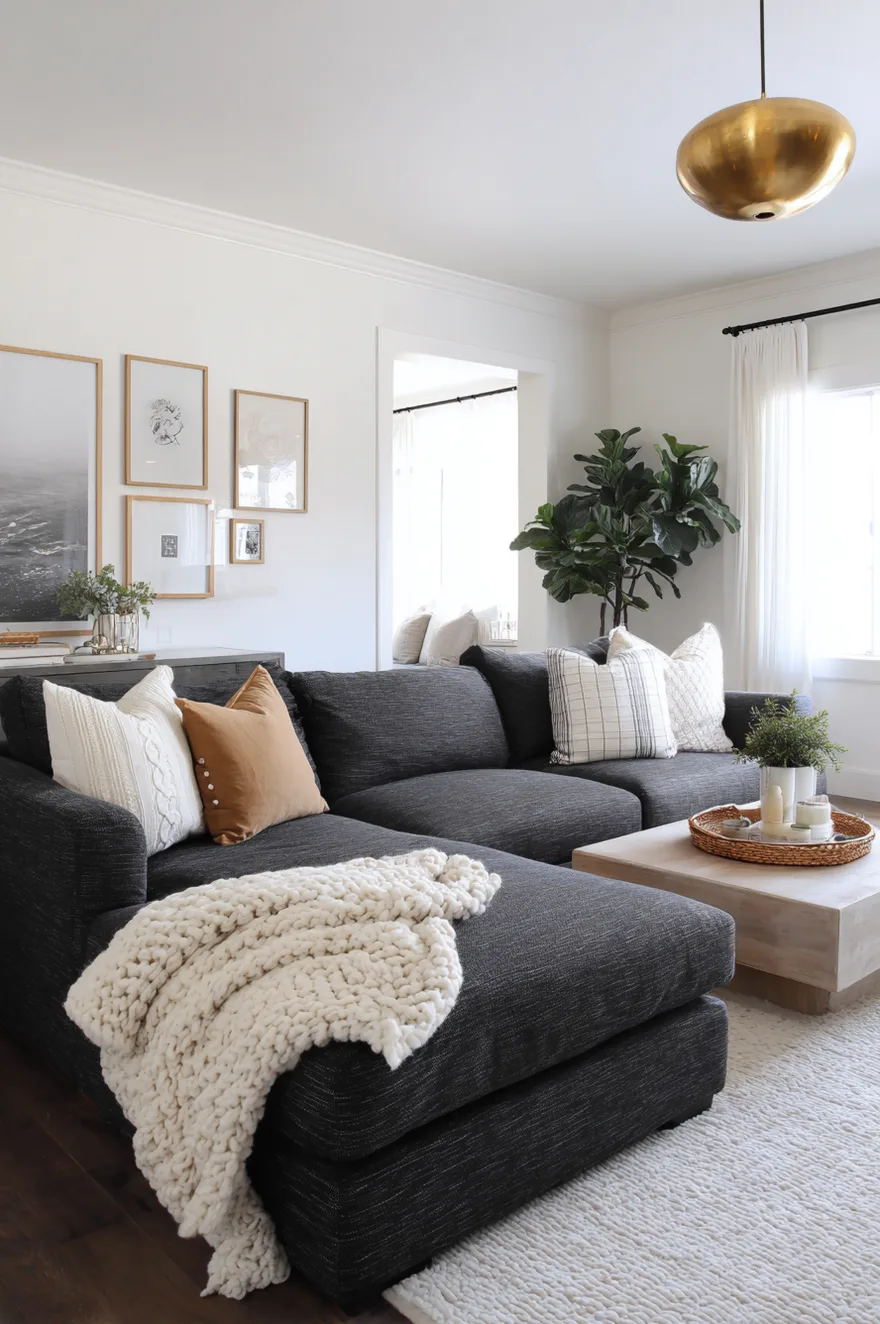
Charcoal and dark grey sectionals are frequently avoided because of a concern about heaviness. That concern is valid but manageable – the conditions under which a charcoal sectional works well are specific, and when those conditions are met, the result is one of the most visually resolved living room configurations available. The key is understanding what charcoal needs from its surroundings to perform well.
Charcoal needs contrast above all else. A light area rug – cream, warm white, light grey – creates a bright ground plane that keeps the dark sectional from visually collapsing into the floor. Light walls – warm white or very pale taupe rather than cool grey – give the charcoal something to read against. A natural wood or light-finished coffee table creates foreground contrast that keeps the dark mass of the sectional from dominating the arrangement. Without these contrasts working simultaneously, charcoal reads as heavy. With them, it reads as grounded and rich.
Metallics perform particularly well in charcoal sectional living rooms because they catch and reflect light in a way that lifts the room’s energy. A brass arc floor lamp, gold picture frames, bronze candle holders – any of these introduce warmth and reflectivity that counterbalances the cool darkness of the sofa. For decor ideas specifically, large architectural plants – a rubber tree, a monstera, a dark-stemmed bird of paradise – create a layering of darks that reads as intentionally rich rather than accidentally gloomy.
Sectional Living Room With an Accent Chair
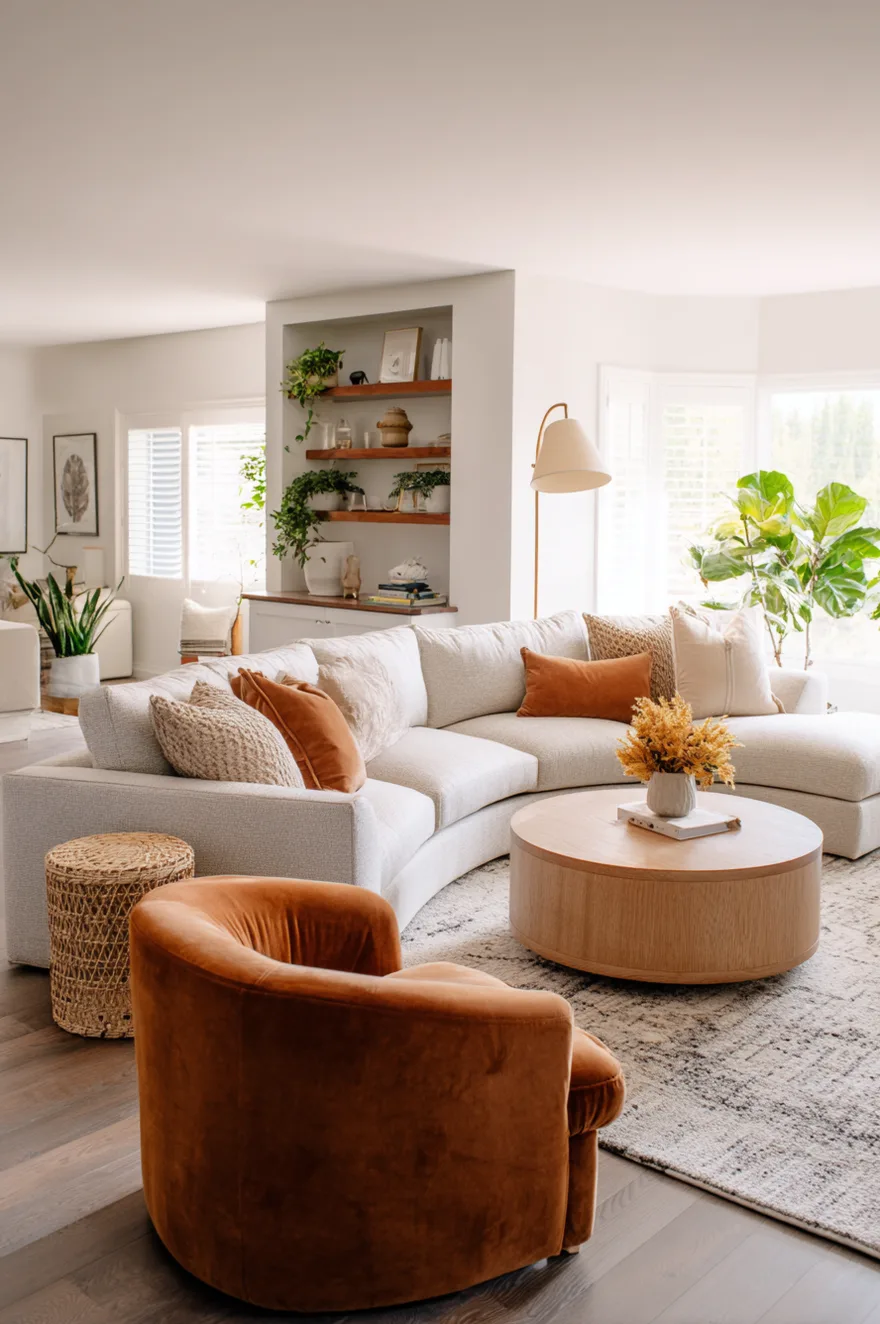
The accent chair is the piece most frequently mishandled in sectional living rooms. The instinct to match it to the sectional produces a showroom effect – coordinated but lifeless. The instinct to contrast it dramatically produces a room that looks like two different design visions competing for the same space. The correct approach sits between these two failure modes: the accent chair should be in conversation with the sectional, sharing color family or material language, while introducing something the sectional does not offer.
Shape is the most reliable differentiator. A sectional is almost always rectilinear – straight arms, angular silhouette, flat-front cushions. An accent chair with a curved back, a barrel profile, or a softer overall silhouette introduces formal contrast that makes both pieces read more clearly. For color, the chair should pick up a tone that is present in the room’s palette but not dominant – a terracotta chair in a room where terracotta appears only as a small pillow accent, or a sage green chair in a room where sage appears in the plant life but nowhere in the upholstered pieces.
Placement is as important as selection. The accent chair positioned at a 45-degree angle to the sectional’s end, with a small side table between them, creates a functional conversation zone with clear visual logic. The side table anchors the relationship between the two pieces. A floor lamp positioned behind and above the chair turns it into a lit destination rather than just a secondary seat, and adds a light layer to the room that makes the entire arrangement feel more resolved after dark.
Brown and Taupe Sectional Living Room Decor
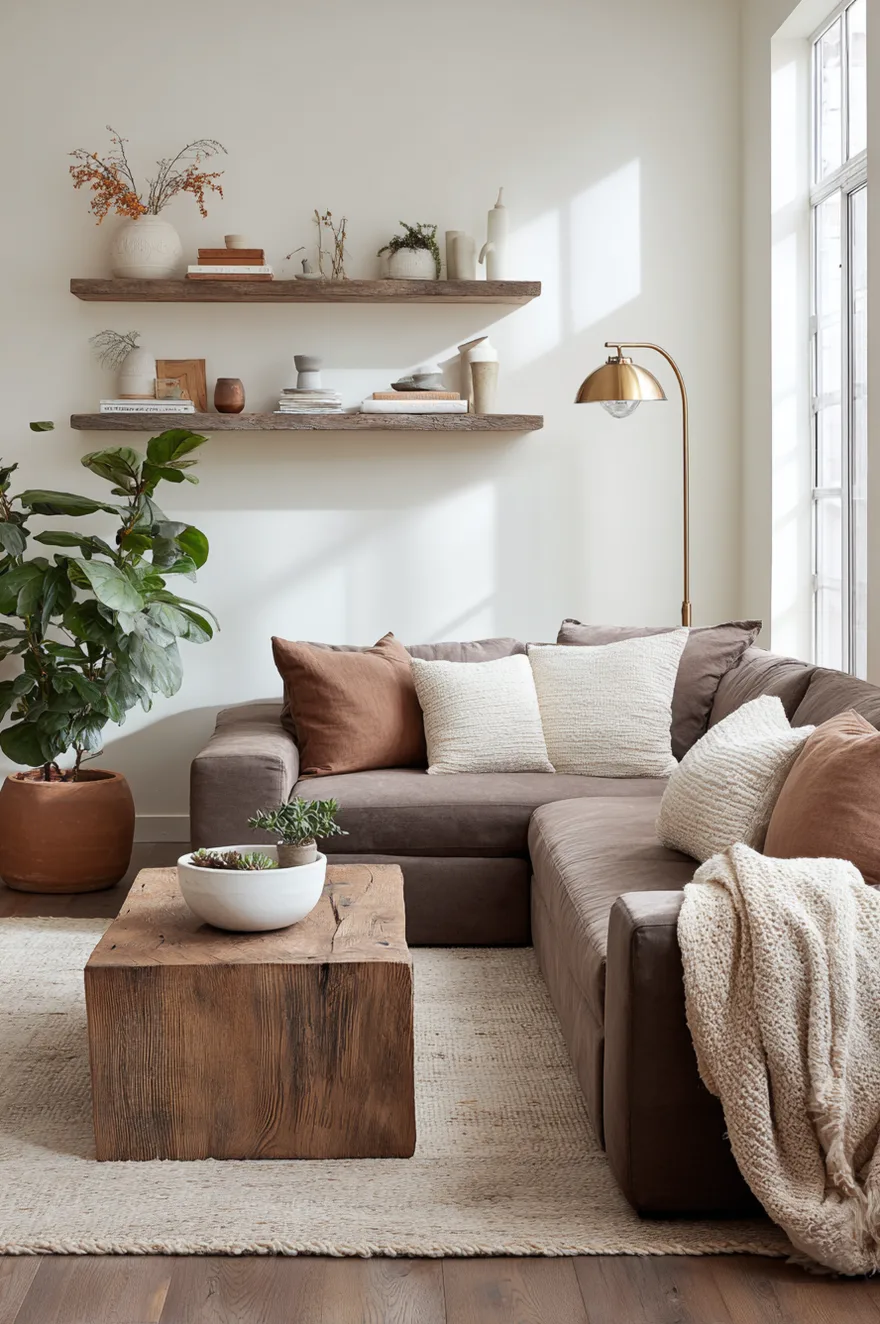
Brown and taupe sectionals went through a period of being considered dated – associated with the early 2000s preference for heavy leather furniture and dark wood paneling. That association no longer holds. The current approach to warm brown and taupe upholstery is fundamentally different in material and execution: lighter in tone, more textural in fabric, and surrounded by organic rather than conventional materials. The result is a sectional living room that reads as grounded and natural rather than heavy.
The material pairing principle for brown and taupe sectionals is consistency of register. Warm earthy materials – jute, natural wool, unfinished or lightly oiled wood, terracotta ceramics, linen – sit in the same tonal family as warm brown upholstery and reinforce it. Cool or synthetic materials – lacquered surfaces, chrome, stark white ceramics, polished stone – create a tonal clash that makes the warm sofa look dated rather than considered. The surrounding materials should feel like they came from the same landscape as the sectional.
The contrast problem in brown and taupe sectional rooms is different from other neutral palettes. The risk is not coldness but muddiness – too many warm mid-tones at similar values with insufficient differentiation. The correction is introducing cream and warm white at the top of the value range: cream throw pillows, a cream or oat area rug, white ceramic pieces on the coffee table. These lighter elements create the separation that prevents the room from reading as a single undifferentiated warm mass.
Green Sectional Living Room Ideas
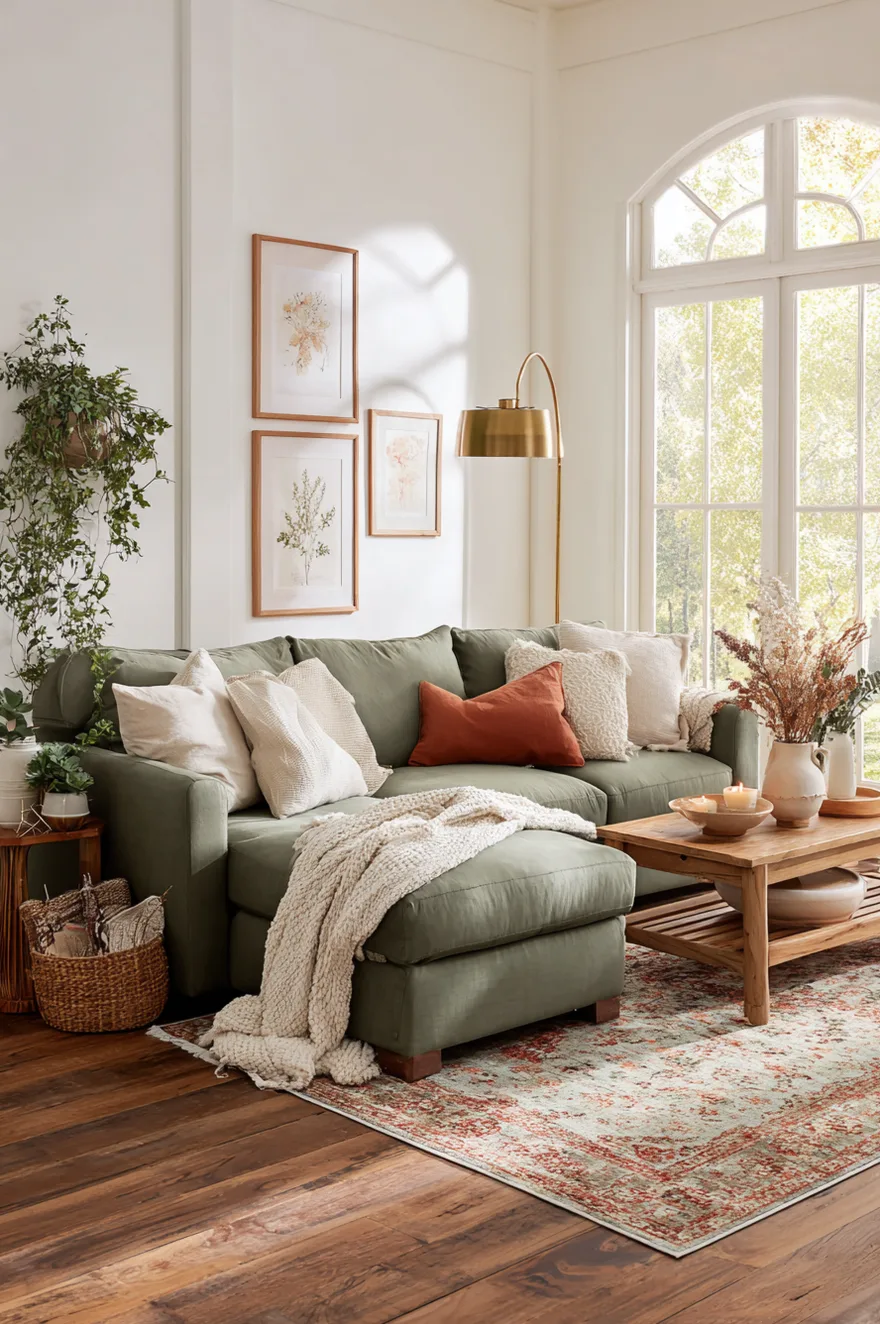
Green is the sectional color with the most staying power of any current trend, and the reason is material rather than aesthetic. Green connects to the natural world in a way that other fashion colors do not, which means it does not carry the expiration date that purely trend-driven choices carry. The question is not whether to choose green but which green – and that decision has significant downstream implications for every other element in the room.
Sage and olive green sit close enough to the neutral spectrum that they behave like sophisticated neutrals in practice. They pair with warm wood, brass, cream, jute, and terracotta without requiring any design gymnastics. A sage green sectional in a room with warm wood floors, cream walls, and brass lighting reads as a resolved, organic palette. The green is present but not assertive. Forest and hunter green are a different proposition – they carry more visual weight, work better with richer materials like velvet and dark wood, and produce a more deliberately moody sectional living room design.
The one consistent principle across all green sectional colors is that the surrounding palette should lean warm rather than cool. Cool grey walls with a green sectional produce a room that feels slightly off – the tones compete without resolving. Warm white walls, warm wood floors, and warm-toned textiles let the green read clearly and cleanly. Greenery and plants are particularly effective styling elements around a green sectional because the repetition of the color in a different material register reinforces the organic quality of the room.
Modern Reclining Sectional Living Room Design
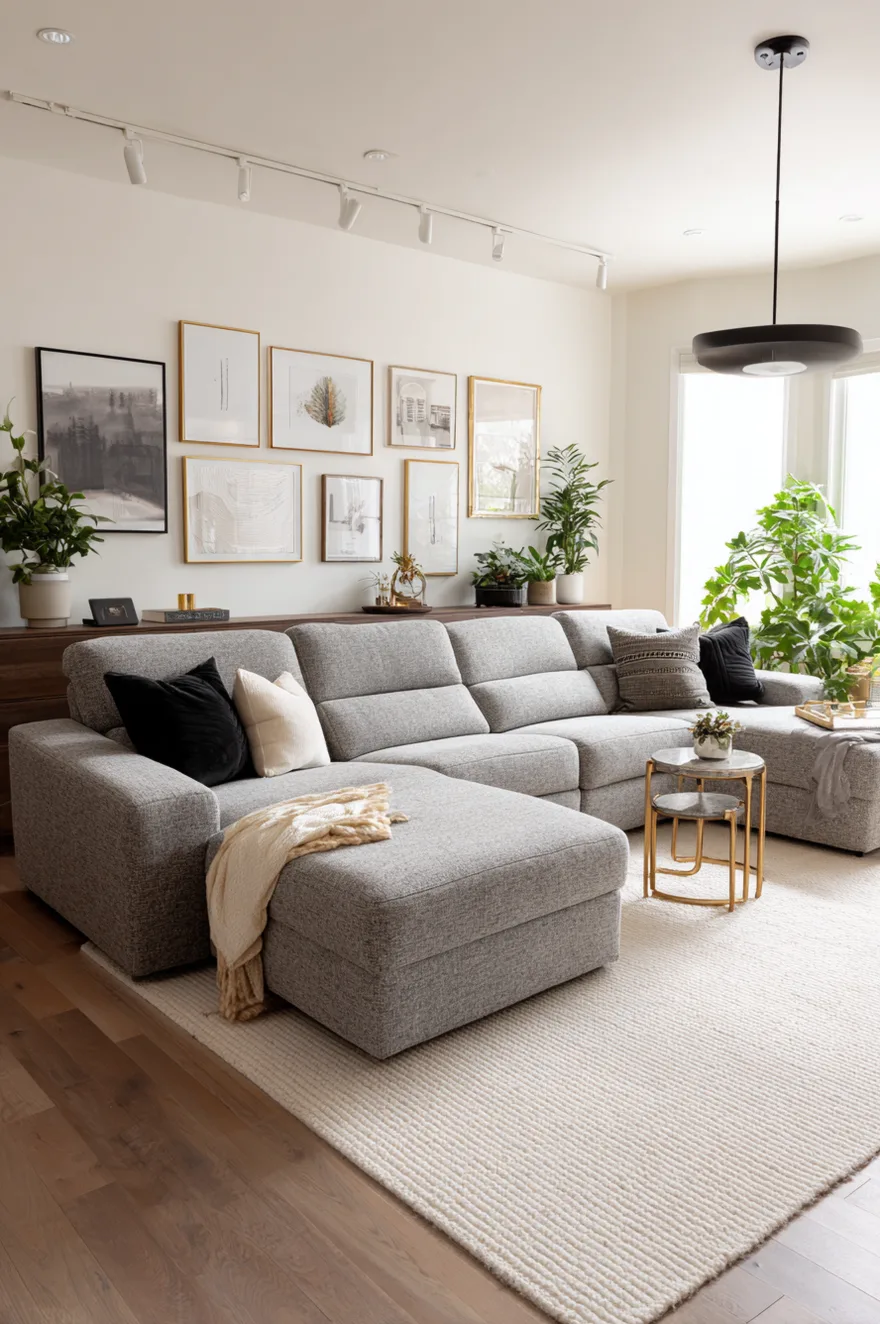
The reclining sectional has a design problem that is partly functional and partly perception-based. Functionally, traditional reclining sectionals were engineered for mechanism performance rather than aesthetic refinement – thick arms to house the reclining hardware, high backs for support in the reclined position, heavy proportions throughout. These engineering choices produce a sofa that works well mechanically but reads poorly in any room where design coherence is a priority.
The modern reclining sectional category has addressed most of these issues. Power recline mechanisms now integrate into slimmer profiles. Arms can be narrow. Back heights have come down. The result is a reclining sectional that, in a well-chosen fabric and colorway, is visually close to a non-reclining sofa with standard proportions. The selection criteria that matter most: arm width under four inches, back height at or below 34 inches, power mechanism with no external handles or visible hardware, and a fabric in grey, taupe, or warm white with a smooth or very subtle texture.
The coffee table decision is where reclining sectional living rooms most often fail stylistically. A standard fixed coffee table at typical height becomes a physical obstacle when the footrest extends. Nesting tables, C-shaped side tables, and ottomans with trays address this practically while still reading well aesthetically. A set of brass and marble nesting tables beside a modern grey reclining sectional is a genuinely elegant solution – it solves the functional problem without signaling that a functional problem was being solved.
Light Gray Sectional Living Room Decor
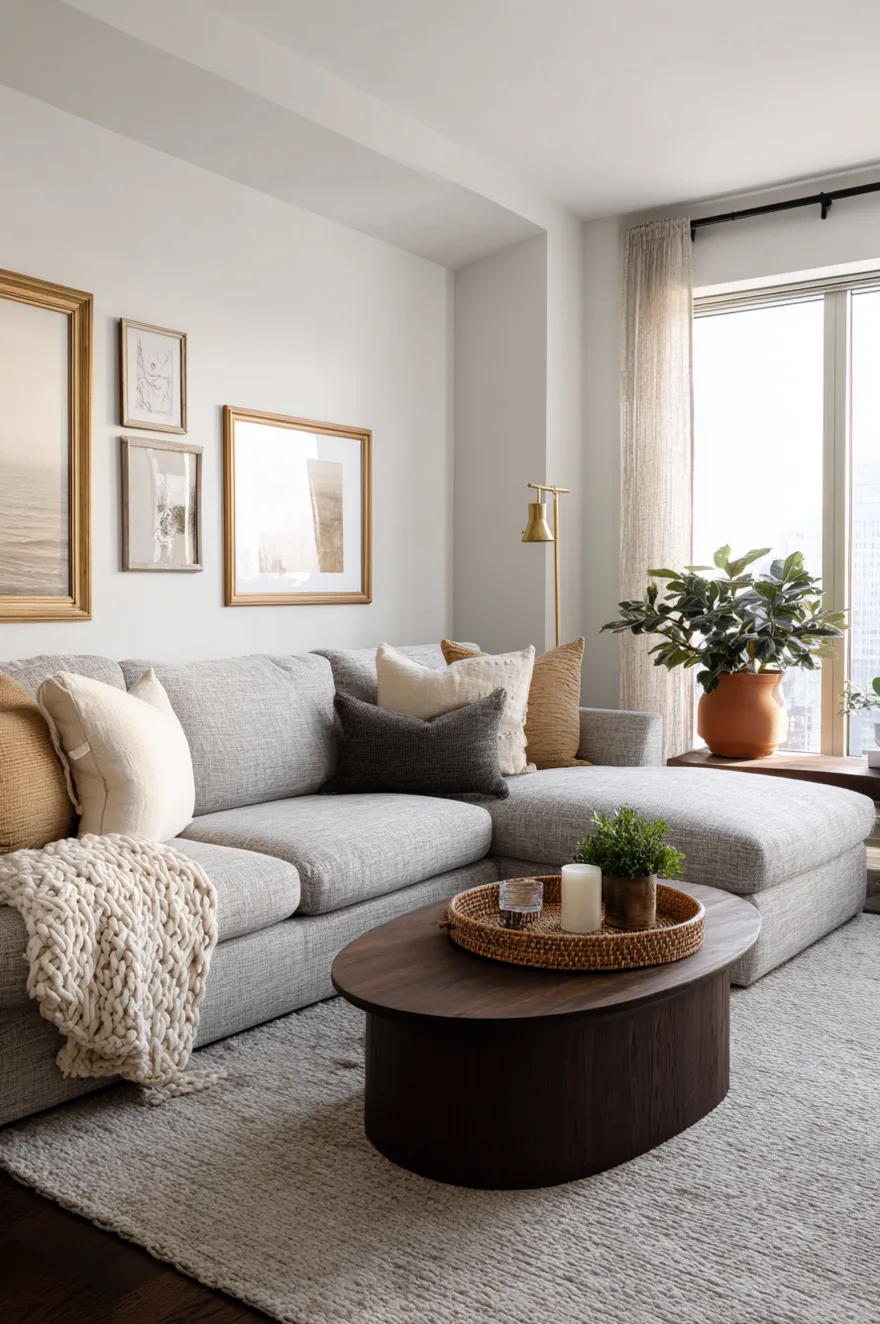
Light grey is the sectional color most susceptible to the washed-out problem – a room where every element sits at a similar mid-tone value and the result is visual flatness rather than visual calm. The two look similar in description but feel completely different in person. Visual calm comes from tonal harmony with deliberate contrast points. Visual flatness comes from tonal similarity with no contrast at all.
Addressing this requires understanding value contrast as a design tool. In a light grey sectional living room, you need at least one element that reads as significantly darker than the sofa – a dark wood coffee table, a near-black picture frame, a charcoal throw pillow, a large dark-leafed plant. This element is not necessarily a focal point. It is a contrast anchor, giving the eye a reference point that makes the light grey read as light rather than as nothing in particular.
The warmth dimension is equally important. Light grey is a cool color by nature, and a room that is both tonally flat and cool in temperature is uncomfortable to spend time in regardless of how comfortable the sofa is. Warm wood tones, brass or gold metal accents, cream and oat textiles, and warm-toned artwork pull the room’s temperature up. A large textured area rug in warm greige or cream with a subtle woven pattern does more work per square foot than almost any other element in this context – it introduces warmth, pattern, and texture simultaneously.
Sectional Living Room Layout Ideas for Open Plan Spaces
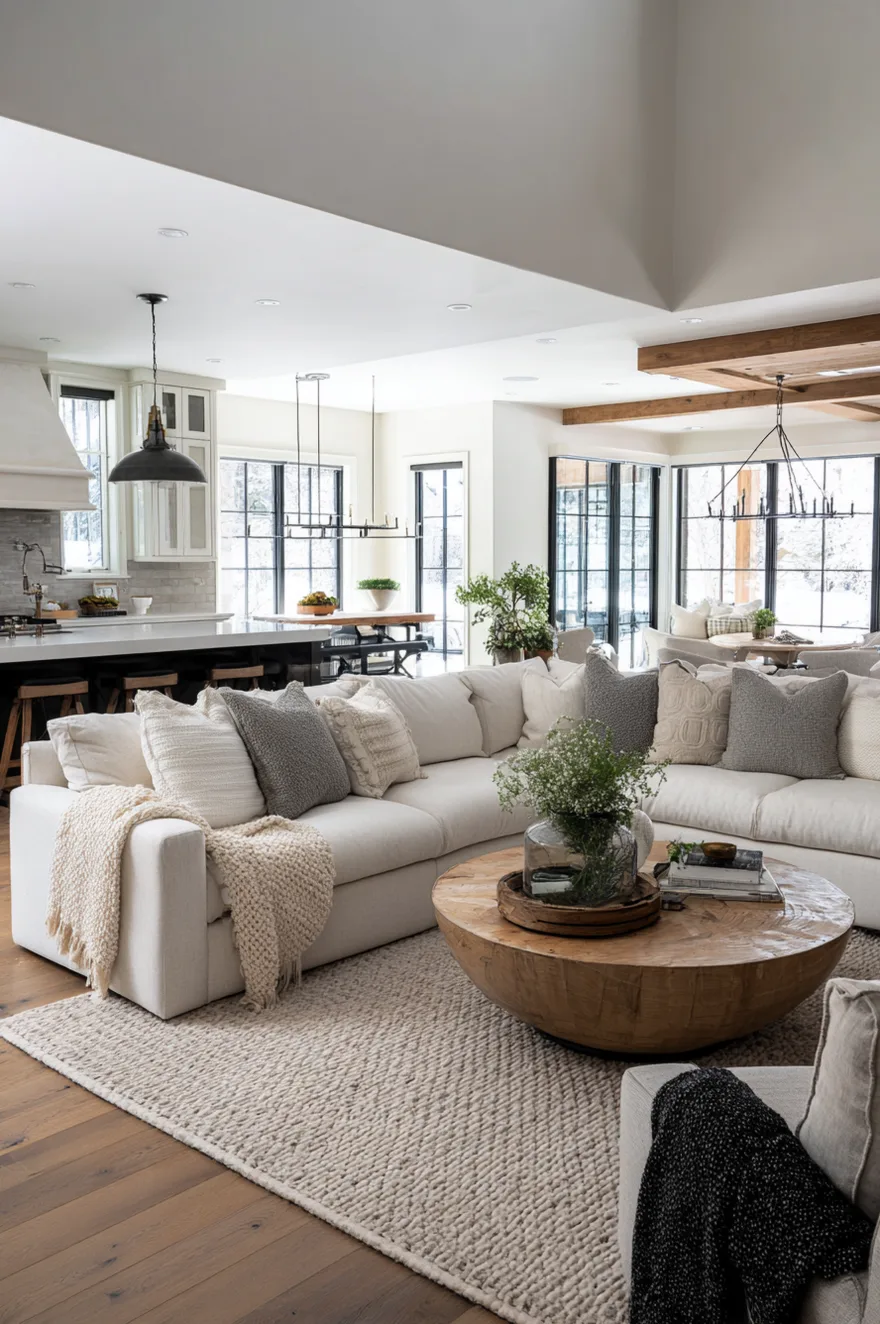
Open plan living rooms expose the fundamental spatial challenge of sectional furniture: a sectional is large enough to define a zone, but without walls to anchor it, that zone can feel arbitrary. The most common open-plan sectional arrangement – sofa pushed against the wall, television on the opposite wall, large empty floor space in between – produces a room that looks like a waiting area rather than a designed living space. The sofa is too far from the television, the room has no defined center, and the open plan reads as a limitation rather than an asset.
The correct approach is to float the sectional in the space – pulling it away from the wall and using its back as a zone boundary. In a kitchen-dining-living open plan, the back of the sectional positioned toward the dining or kitchen zone creates a clear separation between spaces without any physical divider. The back of the sofa becomes the living room’s rear wall. A large area rug encompassing the entire seating arrangement reinforces this boundary and gives the living zone a defined footprint within the larger room.
Scale becomes more critical in open plan spaces than in enclosed rooms. An undersized sectional in a large open plan reads as furniture rather than architecture – it looks like it was placed rather than designed. The sectional needs enough physical presence to hold its own against the volume of the space. In open plan rooms over 400 square feet, a U-shape configuration or a large L-shape with a substantial chaise is typically the minimum for the sofa to read as a genuine zone anchor. The coffee table in the center of the arrangement provides the visual center of gravity that makes the layout feel purposeful.
Black Sectional Living Room Ideas
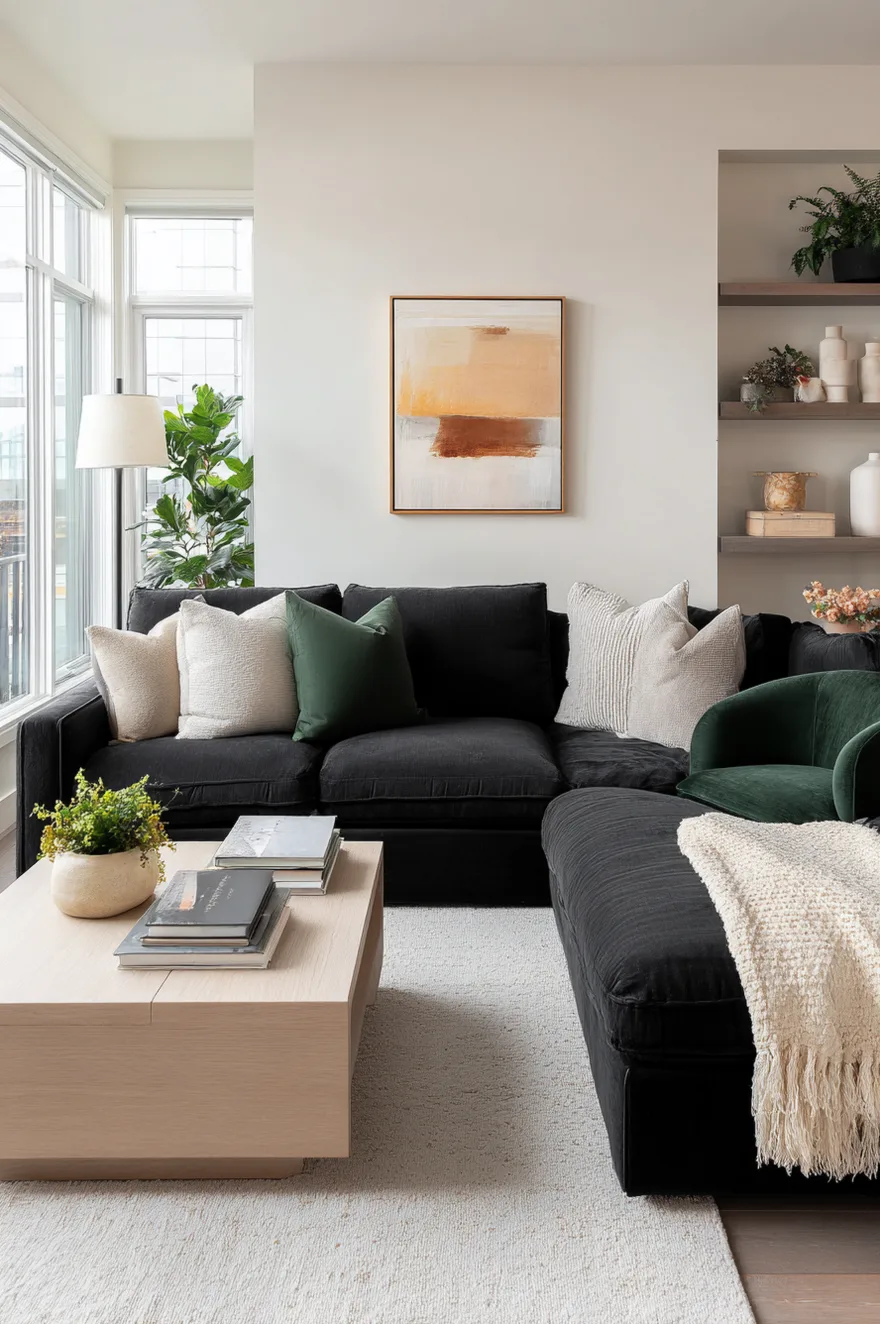
A black sectional is the highest-commitment color choice in the category, and that commitment is worth examining before making it. Black does not fade into the background the way grey or taupe does. It does not blend with surroundings or allow itself to be minimized by styling choices. It asserts itself as the primary visual element in the room, and every other design decision gets made in relation to it. That quality is the source of both its design strength and its design risk.
The non-negotiable conditions for a black sectional to work well: light walls, a light to mid-toned area rug, and pale throw pillows. These three elements are not optional styling choices – they are structural requirements. A black sectional against a dark wall, on a dark floor, with dark accessories produces a room that is visually oppressive. The same black sectional against warm white walls, on a light grey or cream rug, with cream and warm white pillows reads as a deliberate, sophisticated design anchor.
The most effective color accent for a black sectional is a deep jewel tone rather than a bright or pastel color. Forest green, burgundy, deep cobalt, or rich rust in a throw pillow or accent chair introduces color with enough saturation to hold its own against the black rather than washing out next to it. These deep accent tones also reinforce the sense of intentionality – they signal that the black sectional was a design choice rather than a default, which is exactly the impression a black sectional living room should make.
Sectional Living Room Apartment Ideas
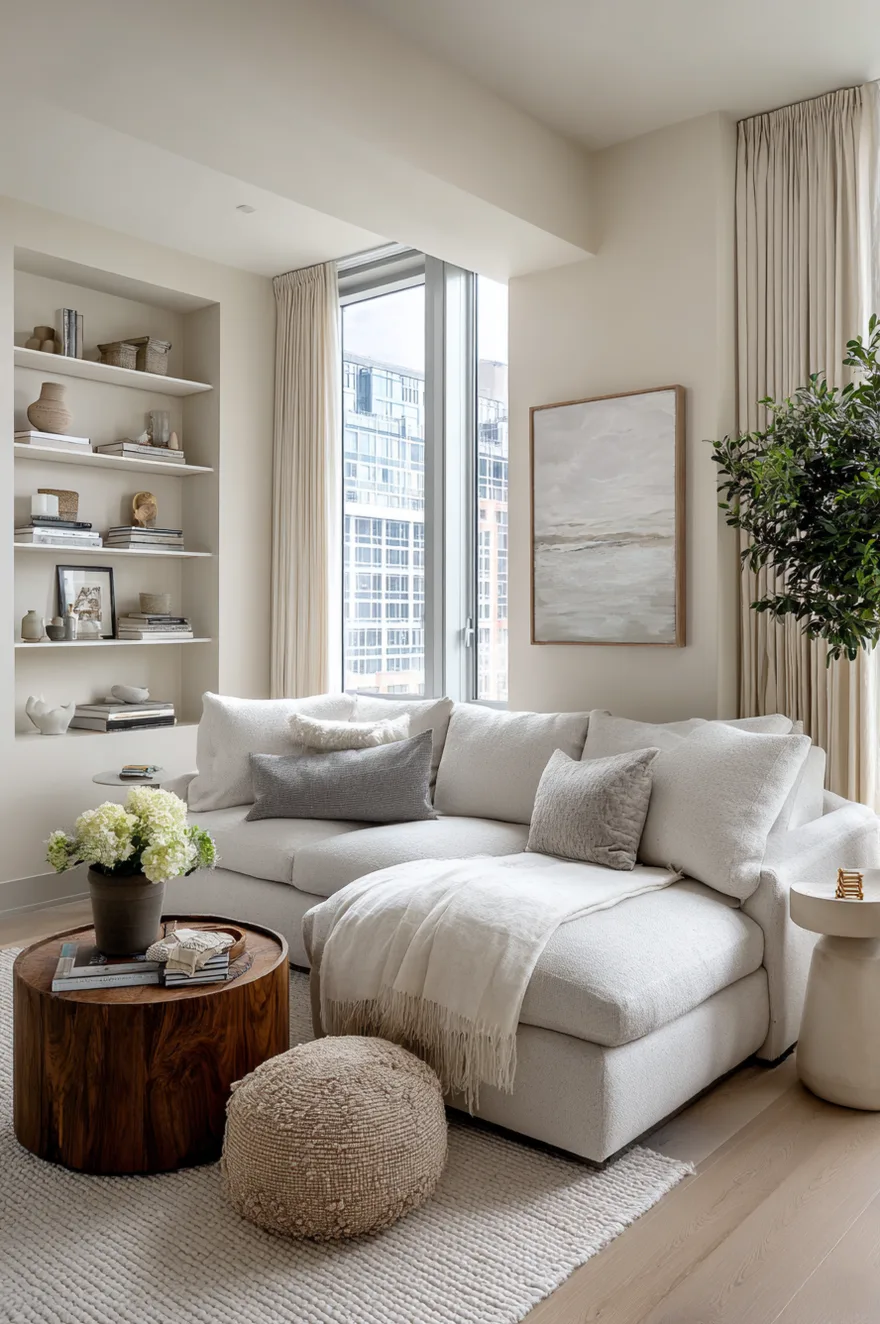
Apartment sectional living rooms require a different planning framework than house living rooms. The primary constraint is not just floor space but proportion – apartments often have lower ceilings and smaller windows relative to floor area than houses do, which means a large sectional can feel more dominant in an apartment than the same piece would in an equivalently sized house room. The sectional needs to be selected and positioned with this proportional sensitivity in mind.
The most functionally intelligent use of a sectional in an apartment is as a zone divider rather than a wall-hugging sofa. A compact sectional or chaise configuration positioned with its back toward the entry or kitchen area creates a defined living zone within an open-plan apartment floor plate. This approach gives the apartment the feel of a room-within-a-room without requiring any structural intervention. The front of the sectional faces a television wall or window, and the back acts as the living area’s boundary.
Modular sectional configurations – where individual pieces can be added, removed, or repositioned – offer the most practical long-term value in apartment living because they adapt to different floor plans without requiring a full furniture replacement. Selection criteria for apartment sectionals: total longest dimension under 100 inches in rooms under 12 feet wide, low back profile to preserve sightlines and visual openness, and reversible chaise orientation to allow layout flexibility as needs change. Decor restraint is equally important – one substantial piece of art, one significant plant, storage-integrated furniture wherever possible.
Beige Sectional Living Room Decor
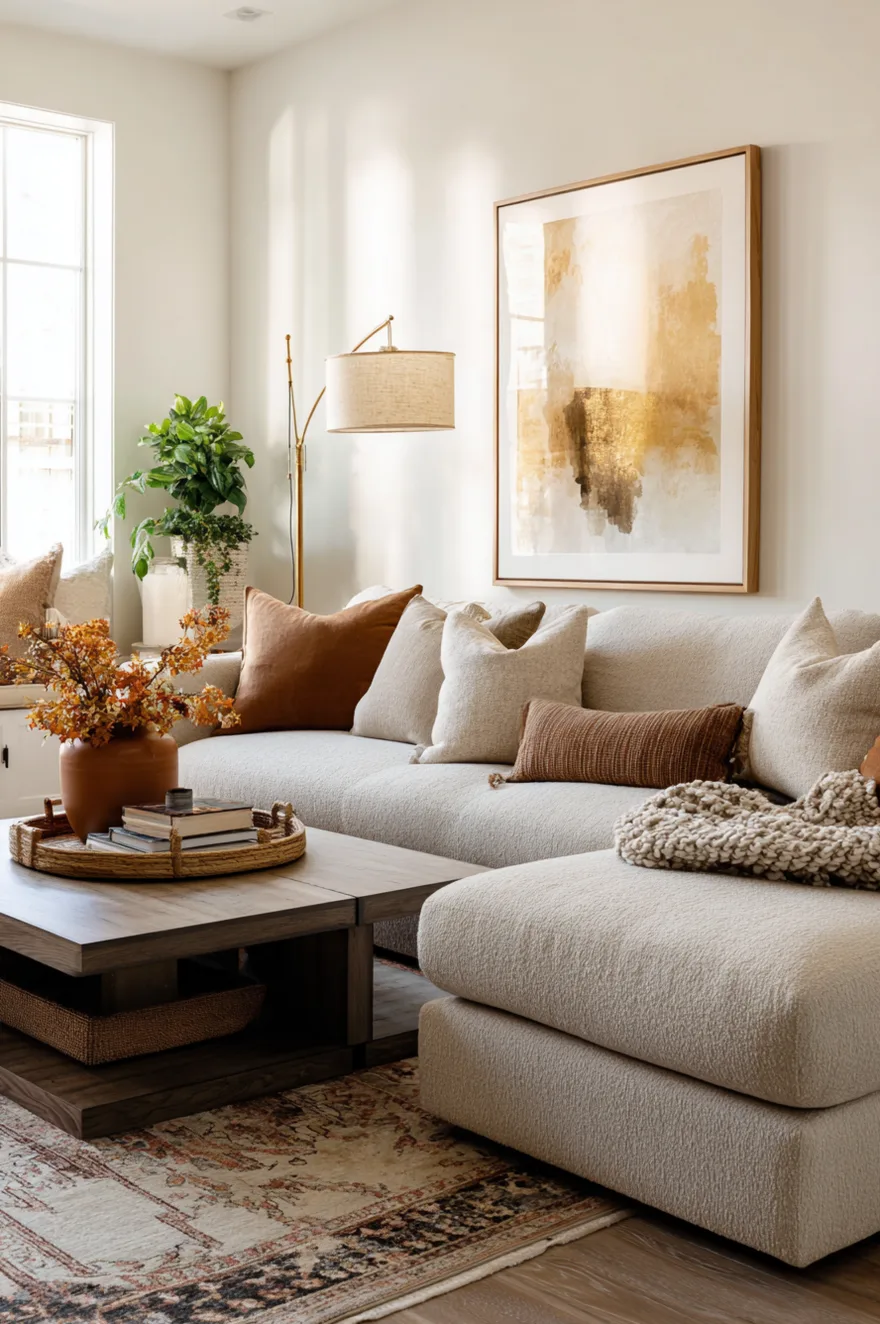
Beige has been the subject of sustained design criticism for years, most of it based on a version of beige that was genuinely problematic – flat, textureless, builder-grade beige in rooms that lacked contrast, material interest, or any evidence of deliberate choice. That version of beige deserved the criticism. The current rehabilitation of beige as a serious design color is based on a fundamentally different execution: beige with texture, beige with contrast, beige as a warm neutral foundation rather than a default.
The material choice for a beige sectional is where most of the design work happens. Beige in a boucle, a linen weave, or a textured cotton has surface interest that reads as intentional. Beige in a flat performance fabric reads as default. The fabric texture signals whether the color was chosen or whether it was simply available. From there, the surrounding decor needs contrast at multiple scales – a dark wood coffee table for large-scale contrast, a rust or terracotta throw pillow for mid-scale color contrast, a patterned area rug for surface contrast at floor level.
The single most impactful addition to a beige sectional living room is a large piece of artwork with warm, saturated color. An abstract painting in ochre, burnt sienna, and warm brown, or a landscape print in earthy greens and tans, introduces a concentrated dose of color and visual complexity that the rest of the room’s neutral palette cannot provide. This piece should be large enough that it reads from across the room – a small print above a large sectional reads as an afterthought, which undermines the design coherence of everything around it.
Finding the Sectional Living Room That Works for You
The consistent principle across all of these sectional living room ideas is that the sofa is a starting condition, not a solution. Its color, scale, and placement establish the parameters within which every other decision gets made. Get those parameters right – appropriate scale for the room, correct orientation for the traffic flow and focal points, a color that gives the surrounding palette somewhere to go – and the room has the structural foundation it needs to work.
The decisions that matter most after the sectional itself: the area rug size and tone, the coffee table material and height, the first accent color introduced through pillows or a chair, and the lighting layers that make the room function at different times of day.
These four elements, resolved in relation to the sectional, determine whether the room feels designed or assembled. Most of the sectional living room problems I see in practice are not sofa problems. They are rug problems, coffee table problems, or lighting problems that were addressed too late or not at all.
See you soon,
Rachel